
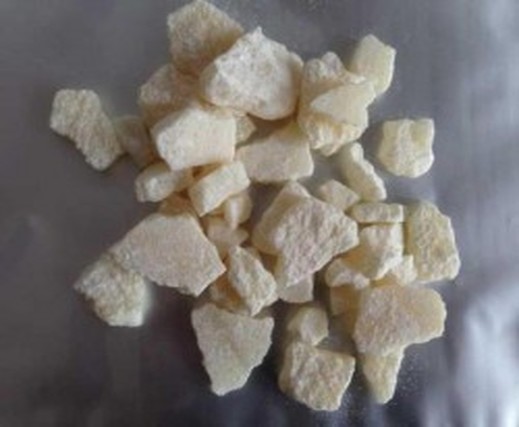
Description
4-ethylnaphthalen-1-y l-(1-pentylindol-3-yl)methanone
4-ethylnaphthalen-1-y l-(1-pentylindol-3-yl)methanone
| Description | JWH 182 is a potent synthetic cannabinoid (CB), activating the central CB1 receptor with a Ki value of 0.65 nM and the peripheral CB2 receptor with a Ki value of 1.1 nM. Its effects in cells and animals are unknown. |
| CAS RN | 824960-02-3 |
| Product Name | 4-Ethylnaphthalen-1-yl-(1-pentylindol-3-yl)methanone |
| Molecular Formula | C26H27NO |
| Molecular Weight | 369.5 |
| IUPAC Name | (4-ethylnaphthalen-1-yl)-(1-pentylindol-3-yl)methanone |
| InChI | InChI=1S/C26H27NO/c1-3-5-10-17-27-18-24(22-13-8-9-14-25(22)27)26(28)23-16-15-19(4-2)20-11-6-7-12-21(20)23/h6-9,11-16,18H,3-5,10,17H2,1-2H3 |
| InChI Key | LACIUQLUNACUKC-UHFFFAOYSA-N |
| SMILES | CCCCCN1C=C(C2=CC=CC=C21)C(=O)C3=CC=C(C4=CC=CC=C43)CC |
| Appearance | Solid powder |
| Purity | >98% (or refer to the Certificate of Analysis) |
| Shelf Life | >2 years if stored properly |
| Solubility | Soluble in DMSO |
| Storage | Dry, dark and at 0 – 4 C for short term (days to weeks) or -20 C for long term (months to years). |
| Synonyms | JWH-182; JWH 182; JWH182; |
| Origin of Product | United States |
Abstract
Synthetic cannabinoids (SCs) are gaining increasing importance in clinical and forensic toxicology. They are consumed without any preclinical safety studies. Thus, controlled human pharmacokinetic (PK) studies are not allowed, although being relevant for interpretation of analytical results in cases of misuse or poisoning. As alternative, in a controlled animal experiment, six pigs per drug received a single intravenous dose of 200 μg/kg BW each of Δ9-tetrahydrocannabinol (THC), 4-ethylnaphthalen-1-yl-(1-pentylindol-3-yl)methanone (JWH-210), or 2-(4-methoxyphenyl)-1-(1-pentyl-indol-3-yl)methanone (RCS-4). In addition, six pigs received a combination of the three drugs with the identical dose each. The drugs were determined in serum using LC–MS/MS.
A population (pop) PK analysis revealed that a three-compartment model described best the PK data of all three cannabinoids. Central volumes of distribution were estimated at 0.29 L/kg, 0.20 L/kg, and 0.67 L/kg for THC, JWH-210, and RCS-4, respectively. Clearances were 0.042 L/min/kg, 0.048 L/min/kg, and 0.093 L/min/kg for THC, JWH-210, and RCS-4, respectively. The popPK THC pig model was upscaled to humans using allometric techniques. Comparison with published human data revealed that the concentration-time profiles could successfully be predicted. These findings indicate that pigs in conjunction with PK modeling technique may serve as a tool for prediction of human PK of SCs.


